
Radon Mitigation Systems
Professional Installation of Proven Radon Systems to Keep Your Indoor Air Safe




Wake County’s Trusted Radon Specialists
Don't let high radon levels compromise your home's indoor air quality. As a licensed local contractor serving Raleigh, Wake County, and the greater Triangle area, Carolina Casa specializes in professional radon mitigation systems. We design and install active soil depressurization systems tailored for North Carolina basements and crawl spaces. Our guaranteed radon reduction strategies safely vent hazardous soil gases above your roofline, ensuring your family's safety and restoring your peace of mind.
Our Proven Radon Mitigation Process:
Comprehensive System Design: Every home is unique. We start by analyzing your basement, slab or crawl space footprint to determine the most effective suction points and routing path for the ventilation pipes, ensuring maximum gas capture with minimal visual impact to your home.
Precision Sealing & Drilling: To create a vacuum effect, we drill a specialized suction hole into your concrete slab or integrate the system directly into a fully sealed crawl space vapor barrier. We then seal all visible foundation cracks to prevent indoor air from being pulled into the system.
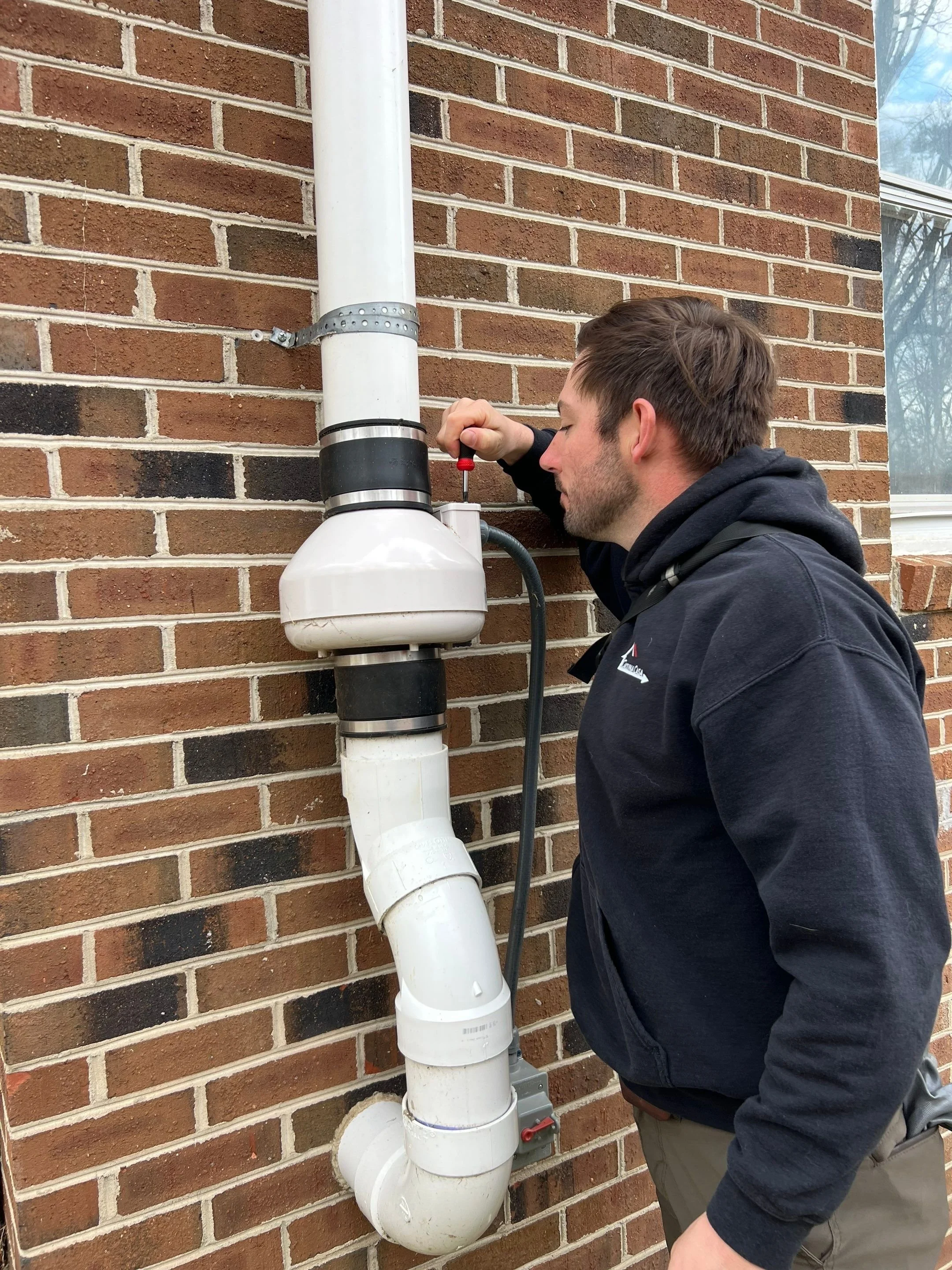
Active Depressurization Installation: We install schedule 40 PVC piping and mount an ultra-quiet, continuous-duty radon fan. This fan runs silently in the background, actively pulling hazardous radioactive soil gases out from beneath your home before they can enter your living space.
Safe Venting & Verification: We route the exhaust piping safely above your home’s roofline, dispersing the radon harmlessly into the outside atmosphere. Finally, we ensure the system is operating perfectly and recommend a post-mitigation test to guarantee your indoor radon levels have dropped to safe margins.
Radon mitigation for homes with a crawl space
Perforated drain pipes are installed underneath the home around the interior perimeter along with a radon fan. These systems paired with our heavy duty vapor barriers provide an optimal solution to keep radon out of your home.

Radon mitigation for homes with a concrete slab
Radon is pulled from underneath the slab through a pipe drilled into the foundation of the home. Typically this is done through the garage or on the side of the home.


With both systems, radon is discharged above the roof line and heavy-duty schedule 40 PVC pipe is used. This is the most effective and quietest way to discharge radon. All of our systems meet NC building code requirements.

We can custom-paint your radon system in any color you choose, allowing it to seamlessly enhance your home’s exterior aesthetic.
Radon Facts
The Silent Threat Lurking in Your Crawl Space
What if the most dangerous thing in your home was something you couldn't see, smell, or taste?
For many homeowners in Raleigh NC and surrounding areas, that threat is radon gas.
Radon is a naturally occurring radioactive gas that seeps from the ground into your home. It's the #1 cause of lung cancer for non-smokers and is responsible for over 21,000 deaths in the U.S. every year.
Because your house "breathes" air up from the ground, your crawl space or basement is the primary entry point for this dangerous gas.
What is Radon Gas?
Radon is created by the natural radioactive decay of uranium found in soil, rock, and water. It's a problem in all 50 states, and [Your Region] has areas known for higher concentrations.
Here’s the simple-but-scary truth:
It's invisible, odorless, and tasteless.
It can be found in any home: new or old, with or without a basement.
It enters through cracks in the foundation, gaps in construction, and, most commonly, through a dirt or unsealed crawl space.
The "stack effect" (where warm air rises and escapes from your home's upper levels) creates a vacuum that actively pulls this soil gas—and the radon it contains—directly into your living area.
How to Know if You Have a Radon Problem
You can't see or smell it, so the only way to know if your home has dangerous radon levels is to test for it.
The EPA recommends that all homes be tested. You can use a DIY short-term test, but for maximum accuracy, we recommend a professional long-term test or continuous electronic monitor, especially if you're buying or selling a home.
If your home's radon level is 4.0 pCi/L (picocuries per liter) or higher, the EPA urges you to take immediate action.
Our Solution: Crawl Space Radon Mitigation
As crawl space experts, we are uniquely qualified to stop radon at its source. A "one-size-fits-all" system won't work. We design a custom radon mitigation system specifically for your home's foundation.
Our systems don’t just trap radon; it actively removes it 24/7/365, giving you permanent peace of mind.
Why Consider Combining Radon Mitigation with an Encapsulation?
For homes with a crawl space, radon mitigation and a crawl space encapsulation can go hand-in-hand.
By combining services, you're not only solving your radon problem but also:
Stopping Moisture & Mold: The vapor barrier prevents mold growth and musty smells.
Improving Air Quality: You'll stop mold spores and dust mites, not just radon.
Saving on Energy: A sealed crawl space is more energy-efficient, lowering your utility bills.
Protecting Your Foundation: You'll prevent wood rot and protect your home's structural integrity.
Your Raleigh NC and Surrounding Areas Radon Mitigation Experts
Don't risk your family's health on a guess. Carolina Casa is a certified and insured radon mitigation provider. We guarantee that our system will reduce your home's radon levels to below the EPA's action level.
Take the First Step to a Safer Home
Protect your family from the dangers of radon gas. Contact us today for a free, no-obligation inspection and estimate for a radon mitigation system.
The "Slab Myth": Why Your Concrete Slab Home Is Still at Risk
Many homeowners believe that if they have a concrete slab foundation (and no crawl space or basement), they are safe from radon gas.
This is a dangerous and common myth.
Radon gas, a cancer-causing radioactive gas, comes from the soil. A concrete slab is not a perfect, airtight barrier. Radon can—and does—find its way into slab homes through tiny, unseen pathways.
Your home's foundation type does not make you immune. The only way to know if your family is safe is to test your home for radon.
How Radon Enters Your Slab Home
Your concrete slab may look solid, but it's porous and has numerous vulnerabilities that radon gas can exploit. The "stack effect" (warm air rising in your home) creates a vacuum that actively pulls these gases from the soil into your living area.
Radon's most common entry points in a slab home are:
Cracks in the Slab: Even hairline cracks, which are a normal part of a home settling, are an open door for radon.
Utility Penetrations: The openings cut for plumbing pipes, electrical wires, and sewer lines are rarely perfectly sealed.
Control/Expansion Joints: The joint where the slab meets the foundation wall (the "cold joint") is a primary entry point.
The Solution: Sub-Slab Depressurization (SSD)
For homes with a concrete slab foundation, the most effective, reliable, and common radon mitigation method is Sub-Slab Depressurization (SSD).
This system is designed to intercept the radon before it ever enters your home.
This system runs 24/7/365, actively removing radon gas and ensuring the air you breathe inside your home is safe.